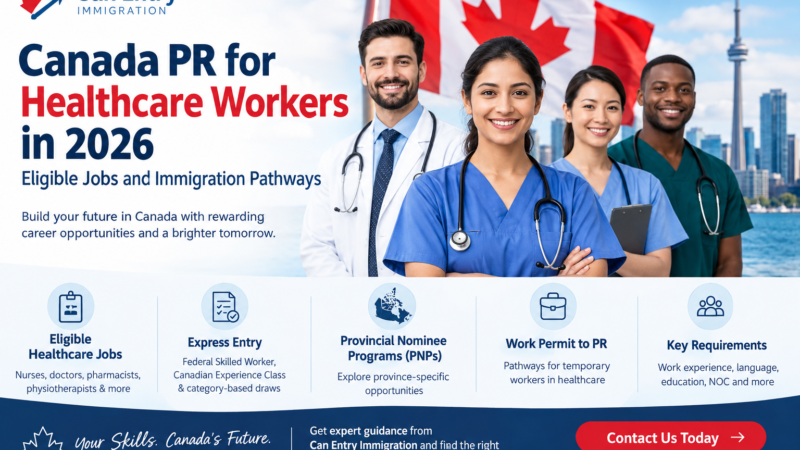
Canada continues to provide immigration pathways for skilled healthcare professionals and workers in health and social services. In 2026, healthcare and social services remains one of the categories used for Express Entry category-based selection. Eligible occupations include nurses, physicians, pharmacists, physiotherapists, medical laboratory technologists, dental professionals, nurse aides and several other healthcare and social-service occupations.
For healthcare professionals outside Canada, this can create opportunities to pursue Canadian permanent residence through Express Entry, Provincial Nominee Programs (PNPs), and other economic immigration pathways. However, having a healthcare occupation does not automatically guarantee Canadian permanent residence. Applicants still need to meet the requirements of the specific immigration program and, where applicable, professional licensing requirements.
If you are a healthcare worker planning to immigrate to Canada in 2026, understanding the available pathways can help you determine which option may fit your education, work experience, language ability and career plans.
Why Healthcare Workers Are Important to Canada’s Immigration System
Healthcare is an important part of Canada’s labour market. Canada’s immigration system continues to use economic immigration programs to attract workers with skills and experience that support the Canadian economy.
For 2026, Canada’s Express Entry system includes a Healthcare and Social Services occupations category. Candidates with qualifying experience in an eligible occupation can potentially be considered in category-based invitation rounds if they also meet the requirements of an Express Entry-managed program and the particular invitation round.
IRCC currently states that candidates under the healthcare and social services category must have at least 12 months of full-time work experience, or an equivalent amount of part-time experience, within the previous three years in one eligible occupation. The experience can be in Canada or abroad and does not have to be continuous.
This makes it important for healthcare professionals to understand both their occupation and their complete immigration profile before choosing a pathway.
Healthcare Jobs Eligible for Express Entry Category-Based Selection
The healthcare and social services category covers a broad range of occupations. Depending on the applicable NOC and current IRCC requirements, eligible occupations include:
- Registered nurses and registered psychiatric nurses
- Nurse practitioners
- Licensed practical nurses
- Physicians and specialists
- Pharmacists
- Dentists
- Physiotherapists
- Occupational therapists
- Psychologists
- Audiologists and speech-language pathologists
- Medical laboratory technologists
- Medical laboratory assistants
- Medical radiation technologists
- Medical sonographers
- Respiratory therapists
- Paramedical occupations
- Pharmacy technicians
- Dental hygienists and dental therapists
- Nurse aides, orderlies and patient service associates
- Social workers
- Social and community service workers
The exact occupation must match the applicable National Occupational Classification (NOC) requirements. Healthcare immigration is not limited only to doctors and nurses. A number of technical, nursing, therapy, laboratory and social-service occupations are also included in the current category.
Applicants should compare their actual job duties and work history with the applicable NOC instead of selecting a NOC based only on their job title. Accurate employment documentation is an important part of an immigration application.
How Much Healthcare Work Experience Is Required?
For the current healthcare and social services Express Entry category, candidates generally need at least 12 months of full-time work experience, or an equivalent amount of part-time experience, within the previous three years in one eligible occupation.
The qualifying experience may be obtained in Canada or abroad, provided the applicant meets the applicable requirements. The experience does not need to be continuous.
Meeting the healthcare category’s work-experience requirement does not by itself create eligibility for Canadian permanent residence. The applicant must also qualify for an Express Entry-managed program and satisfy the requirements of the particular invitation round.
If you want to understand how your healthcare experience may fit into Canada’s PR system, you can review Can Entry Immigration’s immigration services and explore the available permanent residence pathways.
Express Entry for Healthcare Professionals
Express Entry is one of the major pathways healthcare professionals can consider for Canadian permanent residence.
Express Entry manages applications for three federal economic immigration programs:
- Federal Skilled Worker Program
- Canadian Experience Class
- Federal Skilled Trades Program
For many healthcare professionals, the Federal Skilled Worker Program or Canadian Experience Class may be relevant depending on their circumstances and Canadian work experience.
A candidate creates an Express Entry profile and enters the pool if they meet the requirements of an eligible program. IRCC then assigns a Comprehensive Ranking System (CRS) score. Candidates may be considered through general, program-specific or category-based invitation rounds.
Healthcare professionals who meet the requirements of the healthcare and social services category may be considered for category-based selection. However, being in the healthcare category does not mean that an applicant will automatically receive an Invitation to Apply.
IRCC ranks eligible candidates and conducts invitation rounds according to the requirements established for each round. Therefore, an applicant’s overall profile remains important.
Provincial Nominee Programs for Healthcare Workers
Express Entry is not the only option available to healthcare professionals. The Provincial Nominee Program (PNP) can also be an important pathway for eligible healthcare workers.
Canadian provinces and territories operate their own immigration streams based on regional economic and labour-market needs. Depending on the province and stream, healthcare professionals may be assessed based on factors such as:
- Healthcare occupation
- Education
- Work experience
- Job offer
- Language ability
- Canadian work experience
- Employment in a particular province
- Connection to the province
- Other stream-specific requirements
An Express Entry-linked provincial nomination can also have a significant effect on a candidate’s Express Entry profile.
Because provincial immigration programs can change their requirements, healthcare workers should review the current rules of the province and stream they are considering before preparing an application.
Healthcare Workers Already Working in Canada
Healthcare professionals already working in Canada may have additional immigration options depending on their circumstances.
For example, eligible Canadian work experience may be relevant to the Canadian Experience Class (CEC). The CEC is an Express Entry-managed program for eligible skilled workers who have Canadian work experience.
Canadian healthcare experience may also be relevant to certain provincial immigration pathways. A healthcare worker’s current occupation, work permit, employer, language results and length of Canadian experience can all be important when reviewing potential PR options.
If you are already working in Canada, it can be useful to review your permanent residence options before your temporary status approaches its expiry date.
Medical Licensing Is Different From Immigration
One of the most important points for internationally trained healthcare professionals is that immigration eligibility and professional licensing are separate issues.
Obtaining Canadian permanent residence does not automatically give someone authorization to practise a regulated healthcare profession in Canada.
Doctors, nurses, pharmacists and many other healthcare professionals may need to have their education and credentials assessed and obtain registration or a licence from the relevant provincial or territorial regulatory body.
For example, an internationally trained healthcare professional may qualify for an immigration pathway but still need to complete additional education, examinations, credential assessments or registration requirements before practising their profession in Canada.
Healthcare professionals should therefore consider two separate questions:
- Am I eligible for Canadian permanent residence?
- What do I need to become licensed to work in my profession in Canada?
Understanding both processes can help healthcare professionals create a more realistic immigration and career plan.
Language Requirements for Healthcare Workers
Language ability can play an important role in Canadian immigration.
Depending on the immigration program, applicants may need an approved English or French language test. Language results can affect program eligibility as well as the applicant’s CRS score.
Strong language results can improve an applicant’s overall Express Entry profile. French-language proficiency is also one of Canada’s current Express Entry category-based selection categories.
Healthcare professionals should consider completing their language test early so they have enough time to understand how their results affect their immigration profile.
Education and Credential Assessment
Many healthcare professionals applying for Canadian immigration completed their education outside Canada. Depending on the immigration program, an Educational Credential Assessment (ECA) may be required for foreign education.
An ECA and professional licensing are not the same thing. An assessment used for immigration purposes does not automatically authorize someone to practise a regulated healthcare profession in Canada.
Applicants should keep copies of diplomas, degrees, transcripts, professional certificates, registration records and other educational documents.
Having these records organized early can make the immigration and professional licensing processes easier to manage.
Can Healthcare Workers With Low CRS Scores Get Canada PR?
A healthcare occupation can provide an additional route for consideration through category-based Express Entry selection, but it does not guarantee an Invitation to Apply.
Applicants with a lower CRS score should examine their complete profile rather than focusing only on their CRS number.
Potential areas to review can include:
- Provincial Nominee Programs
- Canadian work experience
- Additional education
- Language test results
- French-language ability
- Spouse or partner factors
- Eligible job offers where applicable
- Regional immigration programs
- Other Express Entry categories for which the applicant may qualify
The appropriate pathway depends on the individual’s complete circumstances and the immigration rules in effect when the application is submitted.
Healthcare Workers Coming to Canada on a Work Permit
Some healthcare professionals may first come to Canada as temporary foreign workers and later pursue permanent residence.
This approach can be relevant to healthcare professionals who obtain eligible Canadian employment. Depending on the circumstances, Canadian work experience may become useful for certain permanent residence programs.
Can Entry Immigration provides work permit and immigration services for individuals who want to understand their options for working in Canada.
Before accepting employment, workers should consider their longer-term immigration plans. Their occupation, location, employer, work authorization and Canadian experience can all affect potential future immigration options.
Healthcare Students Can Also Plan for PR
International students who want to build careers in healthcare can also consider how their Canadian education may fit into a longer-term immigration strategy.
The first step is choosing an appropriate Canadian educational program and understanding the current study permit requirements. Can Entry Immigration provides guidance for people interested in studying in Canada.
After graduation, some eligible international students may qualify for a Post-Graduation Work Permit (PGWP), subject to the rules that apply to their program and individual circumstances.
Eligible Canadian work experience obtained after graduation may potentially support future permanent residence pathways. Students should understand that studying in Canada does not automatically guarantee permanent residence, and immigration rules can change.
Why Choose Can Entry Immigration for Healthcare Immigration?
Canadian immigration programs can involve multiple eligibility requirements, changing program rules and detailed documentation. A healthcare professional may have more than one possible immigration pathway but may not know which option best fits their individual circumstances.
Can Entry Immigration provides professional immigration guidance for individuals exploring Canadian permanent residence, Express Entry, Provincial Nominee Programs, work permits, study permits and other immigration pathways.
Our team can help healthcare professionals review factors such as their occupation, NOC, education, work experience, language results and immigration goals before deciding how to proceed.
Whether you are a nurse, doctor, pharmacist, physiotherapist, medical laboratory professional, healthcare technician or another eligible healthcare worker, understanding the requirements before submitting an application can help you prepare more effectively.
Can Entry Immigration can also provide support with document preparation and immigration application processes. However, no immigration consultant can guarantee an Invitation to Apply, provincial nomination, work permit or permanent residence approval. Final immigration decisions are made by the appropriate government authorities.
Start Planning Your Canada PR Journey
Canada’s 2026 Express Entry system includes healthcare and social services as a category for category-based selection. Provincial Nominee Programs and other economic immigration pathways can also provide options for eligible healthcare professionals.
The key is to look beyond your job title. Your work experience, NOC, education, language results, age, Canadian experience, provincial connections and overall immigration profile can all affect which pathway may be available to you.
If you are a healthcare professional interested in Canadian permanent residence, Can Entry Immigration’s Permanent Residency services can help you understand the available pathways and application process.
Ready to explore your Canada PR options? Book an appointment with Can Entry Immigration to discuss your immigration profile and potential pathways with an immigration professional.
You can also contact Can Entry Immigration to learn more about available immigration services and how the team can assist with your Canadian immigration plans.
