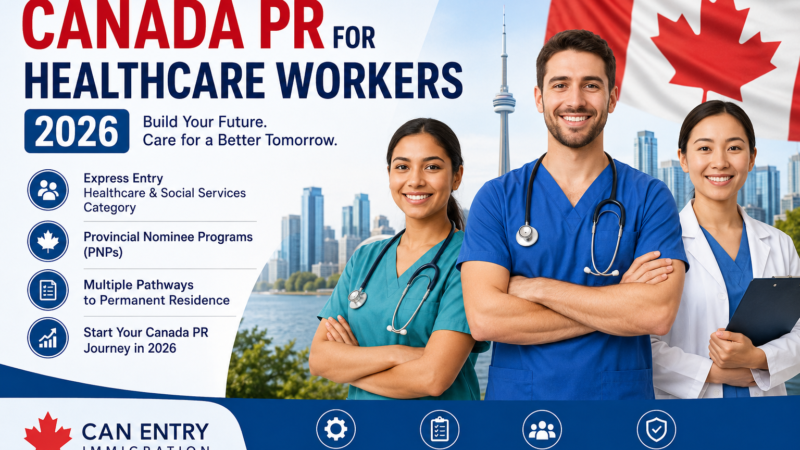
Canada remains an attractive destination for healthcare professionals who want to build a long-term career and apply for permanent residence. In 2026, healthcare and social services continue to be one of the categories used by Immigration, Refugees and Citizenship Canada (IRCC) for Express Entry category-based selection. This makes Canada PR for healthcare workers an important topic for nurses, physicians, pharmacists, dentists, therapists and other eligible professionals.
However, being employed in the healthcare sector does not automatically result in permanent residence. Your occupation, work experience, language ability, education, immigration program eligibility and other factors all matter. The right strategy can also be different for an internationally trained healthcare professional compared with someone who already has Canadian work experience.
This guide explains the main Canada PR options for healthcare workers in 2026 and what applicants should consider before starting their immigration journey.
Why Healthcare Workers Are Getting Attention in Canadian Immigration
Canada’s healthcare system depends on professionals working in hospitals, clinics, community services, long-term care, home care and other areas. Because of this, healthcare occupations have an important place within Canada’s economic immigration framework.
For 2026, IRCC continues to list healthcare and social services occupations among the Express Entry categories. The current category list also includes areas such as French-language proficiency, STEM, trades, education and transport, along with several categories involving Canadian work experience.
For a healthcare professional, this means that immigration planning should go beyond simply asking, “What is my CRS score?” It is equally important to determine whether your professional background fits a current category and whether you meet the requirements of an Express Entry program.
Express Entry and Healthcare Professionals in 2026
Express Entry is an online system used by IRCC to manage applications for Canada’s major federal economic immigration programs. Candidates who qualify can enter the Express Entry pool, where eligible profiles are ranked using the Comprehensive Ranking System (CRS).
IRCC can conduct different types of invitation rounds. These may include general rounds, program-specific rounds and category-based rounds. In a category-based round, IRCC selects eligible candidates who meet the requirements of the particular economic category being targeted.
Healthcare professionals should therefore understand two separate questions: first, whether they qualify for an Express Entry-managed program; and second, whether their experience makes them eligible for a particular category-based round.
The healthcare and social services category is currently part of Canada’s Express Entry selection system. IRCC provides a specific occupation list and requirements for candidates who want to qualify under this category.
If you are unsure which federal immigration program may fit your background, you can explore Can Entry Immigration’s Permanent Residency services for information about Express Entry, PNP and other PR pathways.
Which Healthcare Professionals Can Explore Canada PR?
Healthcare is a broad field, and immigration eligibility depends on the exact occupation rather than simply the general industry in which you work.
Professionals such as nurses, physicians, pharmacists, dentists, psychologists and other eligible healthcare and social-service workers may find opportunities under the applicable immigration categories. IRCC’s 2026 announcement specifically identifies healthcare and social services as a continuing Express Entry priority category.
It is important to check the occupation requirements carefully. Two people working in the same general healthcare environment can have completely different immigration options because their job duties, NOC classification, work history or professional qualifications may differ.
Does Healthcare Experience Guarantee an Invitation to Apply?
No. This is one of the most important points healthcare professionals should understand before making an immigration plan.
Working in a healthcare occupation can potentially make you eligible for a category-based Express Entry round, but it does not mean that every healthcare worker will receive an Invitation to Apply (ITA).
IRCC ranks candidates in the Express Entry pool and establishes the requirements for each invitation round. The number of invitations, round type and ranking requirements can vary.
Your overall profile therefore remains important. Language results, age, education, work experience and other CRS factors can influence your ranking.
Canadian Experience Can Strengthen Your Immigration Options
Healthcare workers who are already employed in Canada may have a different set of possibilities from applicants applying directly from overseas.
The Canadian Experience Class (CEC), for example, is designed for skilled workers who have eligible Canadian work experience and want to become permanent residents. Applicants must still meet the program’s specific requirements, including applicable language and work-experience criteria.
This can make Canadian employment an important part of a longer-term immigration strategy for some temporary foreign workers. However, obtaining a job in Canada should not be viewed as an automatic PR guarantee.
If you are already working in Canada, it can be useful to review your current status, occupation, employment history and future PR options before your work permit approaches its expiry date.
Provincial Nominee Programs for Healthcare Workers
Express Entry is not the only route to Canadian permanent residence. Provincial Nominee Programs can also be important for healthcare professionals.
Canadian provinces and territories have their own immigration priorities. Depending on the province and the stream, healthcare professionals may find opportunities connected to local employment needs, work experience, education, job offers or other eligibility factors.
A provincial nomination can also be particularly valuable when connected to Express Entry because an eligible provincial nomination can significantly improve a candidate’s CRS position.
Because provincial programs can change independently of federal programs, healthcare workers should look at the province where they intend to live and work rather than assuming that the same requirements apply across Canada.
Can Entry Immigration’s immigration services can help applicants explore different Canadian immigration pathways, including permanent residence and provincial options.
Internationally Educated Healthcare Professionals
For professionals trained outside Canada, immigration is only one part of the journey.
Many healthcare occupations are regulated in Canada. That means a person may need to meet the requirements of the relevant provincial or territorial regulatory organization before practising the profession in Canada.
This creates an important distinction between immigration eligibility and professional licensing.
For example, an internationally educated nurse may need to complete credential assessment, examinations, registration and other requirements before becoming authorized to practise as a nurse in a particular province. Similar licensing considerations can apply to physicians, pharmacists, dentists and other regulated professionals.
Healthcare professionals should therefore research licensing requirements at the same time as they research immigration options. Starting this process early may help avoid unexpected delays after arriving in Canada.
Language Ability Matters for Canada PR
Strong English or French language results can be valuable for an immigration applicant. Language proficiency is used in the eligibility requirements of several economic immigration programs and can also affect a candidate’s CRS score.
For healthcare professionals, language ability has an additional practical importance because communication is an essential part of patient care and professional employment.
Applicants should take an approved language test and carefully review the required Canadian Language Benchmark level for their intended immigration program.
French can also provide another potential avenue. French-language proficiency is currently one of the Express Entry category-based selection categories.
Education and Credential Assessment
Many healthcare professionals applying for Canadian immigration completed their education outside Canada. Depending on the immigration program, an Educational Credential Assessment (ECA) may be required for foreign education.
An ECA and professional licensing are not the same thing. An assessment used for immigration purposes does not automatically authorize someone to practise a regulated healthcare profession in Canada.
Applicants should keep copies of diplomas, degrees, transcripts, professional certificates, registration records and other educational documents. Having these records organized early can make the immigration and licensing processes easier to manage.
What About Healthcare Workers Coming to Canada on a Work Permit?
Some applicants may first enter Canada as temporary foreign workers and later pursue permanent residence.
This approach can be relevant to healthcare professionals who obtain eligible Canadian employment. Canadian work experience may become useful for certain permanent residence programs if the applicant satisfies all applicable requirements.
Workers should think about their long-term immigration plan before accepting employment. The occupation, location, employer, work authorization and potential Canadian experience can all affect future options.
Can Entry Immigration offers guidance on Canadian work permit and employment-related immigration pathways. You can learn more through the Can Entry Immigration services page.
Healthcare Students Can Also Plan for PR
International students who want to build careers in healthcare can consider how their education may fit into a longer-term Canadian immigration strategy.
The first step is selecting an appropriate Canadian educational program and understanding the current study permit requirements. After graduation, some eligible students may qualify for a Post-Graduation Work Permit, subject to the rules that apply to their program and circumstances.
Canadian work experience obtained after graduation may potentially support future immigration options.
Students can learn more about studying in Canada through Can Entry Immigration’s Canada Study Permit services.
Graduates can also review information about the Post-Graduation Work Permit (PGWP) as part of their planning.
Healthcare Caregivers and Home Support Workers
Healthcare and home-care workers should also distinguish between professional healthcare occupations and caregiver pathways.
Canada has immigration pathways designed for certain caregivers and home-support workers. These programs have their own requirements, and eligibility should be checked against the current IRCC rules rather than assuming that every healthcare worker qualifies.
Can Entry Immigration also provides information about caregiver immigration pathways to Canada, which may be relevant to applicants whose professional background falls within eligible caregiving occupations.
Documents Healthcare Workers Should Start Collecting
A well-organized document file can make immigration preparation much easier. Depending on the program and personal circumstances, healthcare applicants may need documents such as:
- Passport and identity documents
- Language test results
- Educational certificates and transcripts
- Educational Credential Assessment, where required
- Employment reference letters
- Detailed evidence of work experience
- Professional registration or licensing documents
- Police certificates, where required
- Proof of funds, where applicable
- Medical examination information, where required
- Canadian employment and work permit documents, where applicable
The exact document list depends on the immigration program. Applicants should not submit documents simply because another applicant was asked for them; requirements should be based on the specific application.
How Can Entry Immigration Helps Healthcare Workers
Choosing an immigration pathway can be confusing when several programs appear to fit your background. Healthcare professionals may also have to consider professional licensing, foreign education, language testing, Canadian employment and provincial requirements at the same time.
Can Entry Immigration provides immigration consultation and application support for people exploring Canadian immigration options. Its services include assistance with permanent residence, Express Entry, provincial immigration pathways, work permits, study permits, visitor visas, Super Visas and citizenship applications.
For healthcare workers, the value of professional guidance is often in understanding how the different pieces of an application fit together. An applicant can review their occupation, education, work experience, language results and immigration goals to determine which pathways may be worth considering.
Can Entry Immigration can also assist with document preparation and application support. However, applicants should understand that no immigration consultant can guarantee an ITA, provincial nomination, work permit or permanent residence approval. Final immigration decisions are made by the appropriate government authorities. Can Entry Immigration’s own terms and conditions expressly state that approvals and ITAs cannot be guaranteed.
If you are considering Canada PR as a healthcare professional, you can contact Can Entry Immigration to discuss your immigration plans and available services.
Is 2026 a Good Time for Healthcare Workers to Explore Canada PR?
For eligible healthcare professionals, 2026 presents a reason to pay close attention to Express Entry. Healthcare and social services remains an active Express Entry category, and IRCC has confirmed that it is continuing category-based selection for healthcare and social services occupations in 2026.
That does not mean every healthcare worker will receive an invitation. Immigration selection remains competitive, and eligibility depends on the specific program and category requirements.
The strongest approach is to look at your complete profile rather than focusing on your occupation alone. A higher language score, additional eligible work experience, Canadian experience, education or a provincial pathway could potentially change your immigration options.
Final Thoughts
Healthcare professionals have several potential avenues to explore when planning Canadian permanent residence in 2026. Express Entry category-based selection, the Canadian Experience Class, Provincial Nominee Programs and other economic immigration pathways may all be relevant depending on an applicant’s background.
The key is to identify the pathway that matches your actual qualifications rather than choosing a program simply because it appears popular online.
If you are a nurse, physician, pharmacist, dentist, therapist, healthcare professional, social-service worker or eligible caregiver, reviewing your immigration profile early can help you understand what options may be available.
For personalized assistance, visit Can Entry Immigration’s Permanent Residency page or contact the Can Entry Immigration team to learn more about available immigration services.
Important: Canadian immigration programs, eligibility requirements, occupation categories and selection procedures can change. The information in this article is for general information only and should not be considered legal advice or a guarantee of immigration approval. Always verify the latest requirements with IRCC and the relevant provincial or territorial authority before submitting an application.
Frequently Asked Questions About Canada PR for Healthcare Workers
Can healthcare workers get PR in Canada in 2026?
Healthcare workers may have several potential routes to Canadian permanent residence in 2026. Healthcare and social services is currently an Express Entry category, but applicants must still satisfy the applicable program and category requirements.
Is nursing included in Canada’s healthcare immigration category?
Eligible nursing occupations may be included depending on the occupation list and requirements applicable to the current Express Entry healthcare and social services category. Applicants should verify their exact occupation and work experience against the current IRCC requirements rather than relying solely on their job title.
Can a healthcare worker apply for PR through Express Entry?
Yes, an eligible healthcare professional may be able to use Express Entry if they qualify for one of the programs managed through Express Entry and meet the requirements of the applicable selection round. Express Entry manages the Canadian Experience Class, Federal Skilled Worker Program and Federal Skilled Trades Program.
Can healthcare workers apply through a Provincial Nominee Program?
Potentially. Provincial immigration programs have different requirements, and some may target occupations or workers that meet specific regional labour-market needs. Healthcare professionals should review the requirements of the province and stream relevant to their circumstances.
Do foreign-trained healthcare professionals need a Canadian licence?
Many healthcare occupations are regulated in Canada. Immigration approval and professional licensing are separate processes, so an applicant may need to complete additional registration, examination or licensing requirements before practising a regulated profession.
Can Can Entry Immigration help with Canada PR for healthcare workers?
Can Entry Immigration provides immigration consultation and application support for Canadian permanent residence and other immigration pathways. Healthcare professionals can review their individual circumstances and explore potentially suitable options before proceeding with an application.

admin
Professional immigration consultants helping clients achieve their immigration goals.
Need Help With Your Canada Immigration Application?
Speak with our immigration experts today and receive personalized guidance.
Book Consultation