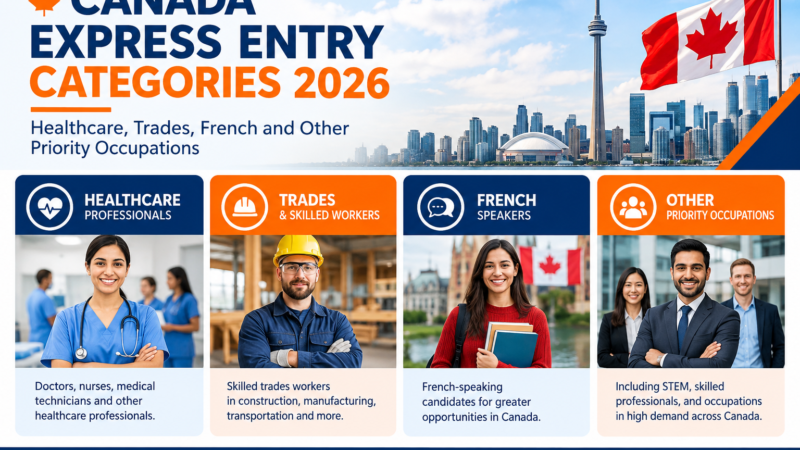
Canada Express Entry remains one of the most popular pathways for skilled workers who want to obtain permanent residence in Canada. In 2026, Express Entry continues to use both general selection and category-based selection to identify candidates whose skills, work experience or language abilities match Canada’s economic immigration priorities.
For foreign workers planning to move to Canada, understanding the Canada Express Entry categories 2026 is important. Healthcare professionals, skilled trades workers, French-speaking candidates and workers in other priority occupations may have opportunities through category-based selection, provided they meet the applicable eligibility requirements.
In this guide, we explain the major Express Entry categories, how category-based selection works, the role of CRS scores, and how candidates can improve their chances of receiving an Invitation to Apply (ITA) for Canadian permanent residence.
What Is Canada Express Entry?
Express Entry is Canada’s online immigration application management system for several economic immigration programs. It is designed for skilled workers who want to become permanent residents of Canada.
The system manages candidates under programs such as the Canadian Experience Class (CEC), Federal Skilled Worker Program (FSWP) and Federal Skilled Trades Program (FSTP). Can Entry Immigration provides professional assistance with Express Entry Canada, including eligibility assessment, CRS strategy, profile preparation and application guidance.
Eligible candidates create an Express Entry profile and enter the candidate pool. Their profile is assessed using the Comprehensive Ranking System, commonly known as the CRS.
IRCC then conducts invitation rounds and selects candidates based on the type of draw being conducted. Some draws may focus on overall CRS ranking, while category-based draws target candidates with specific skills, occupations or language abilities.
What Are Express Entry Category-Based Draws?
Category-based Express Entry selection allows Canada to invite candidates who have specific skills, work experience or language abilities that support Canada’s economic and demographic priorities.
This approach means that candidates should not look only at the latest CRS cut-off. Your occupation, qualifying work experience and language profile may also be important when determining whether you could benefit from a category-based invitation.
However, being employed in a priority occupation does not automatically result in an invitation. Candidates must first qualify for an Express Entry program and satisfy the requirements of the applicable category.
Healthcare and Social Services Category
Healthcare continues to be an important area of Canada’s immigration strategy. Canada’s healthcare system requires qualified professionals across a range of occupations, which makes healthcare experience particularly relevant for skilled workers considering Canadian immigration.
Depending on the applicable category requirements, eligible healthcare and social-service professionals may include nurses, physicians, pharmacists, medical laboratory professionals, social workers and workers in other qualifying occupations.
Healthcare professionals should carefully review their occupation, NOC classification, work experience, education and language test results before creating an Express Entry profile.
Applicants should also remember that immigration eligibility and professional licensing are different matters. A person may qualify for Canadian immigration but still need to obtain provincial or territorial licensing before working in a regulated healthcare profession.
Can Entry Immigration also provides guidance for applicants exploring Canada immigration pathways based on their professional background and long-term settlement goals.
Express Entry for Skilled Trades Workers
Skilled trades are another important area of Canadian economic immigration. Workers with experience in construction, electrical work, plumbing, welding, carpentry, mechanical work and other skilled trades may have opportunities through Canada’s economic immigration programs.
The Federal Skilled Trades Program can be particularly relevant for eligible tradespeople. Can Entry Immigration provides assistance with the Federal Skilled Trades Program Canada and other permanent residence options.
For trades workers, accurate employment documentation is extremely important. Applicants should be able to demonstrate their work history and job duties through appropriate employment reference letters and supporting documents.
If you have worked as a tradesperson outside Canada, your occupation should be carefully matched to the correct NOC before relying on that experience for an immigration application.
French-Language Express Entry Category
French-language ability can provide another opportunity under Canada’s category-based Express Entry system. Canada continues to support French-language immigration outside Quebec as part of its broader immigration objectives.
Applicants with strong French-language skills may benefit from French-language category selection if they meet the required language level and all other eligibility conditions.
Speaking French conversationally is not enough to claim language points. Applicants generally need approved language test results to demonstrate their proficiency for immigration purposes.
For candidates who speak both English and French, improving both language profiles may help strengthen their overall Express Entry strategy. Language ability can also have a significant effect on the CRS calculation.
Other Priority Occupations in Canada
Canada’s immigration priorities can extend beyond healthcare and skilled trades. Depending on the current IRCC categories and eligibility requirements, candidates with experience in other important areas may also have opportunities through category-based selection.
Immigration categories should not be treated as permanent. Canada’s priorities can change as labour-market conditions and government immigration policies evolve. Applicants should therefore check the current requirements before making decisions based on an older Express Entry category.
Does Your CRS Score Still Matter in 2026?
Yes. Category-based selection does not eliminate the CRS system.
Express Entry candidates continue to receive a CRS score based on factors such as age, education, language proficiency, Canadian work experience and other qualifying factors.
For this reason, applicants should consider two parts of their strategy: meeting the requirements for a category and improving their overall CRS profile.
For example, improving English or French language results, obtaining additional eligible education, gaining qualifying Canadian work experience or receiving a provincial nomination may improve a candidate’s competitiveness.
If you want to estimate your potential CRS score, Can Entry Immigration also provides a Canada immigration points and CRS calculator to help applicants understand their potential profile.
Provincial Nominee Programs and Express Entry
Express Entry is not the only pathway to Canadian permanent residence. Provincial Nominee Programs, commonly called PNPs, can provide another option for eligible skilled workers.
Each province and territory has its own immigration priorities. Some programs are designed to attract workers in occupations that are in demand within that particular province.
An Express Entry-linked provincial nomination can be particularly valuable because it can significantly improve a candidate’s CRS position.
Can Entry Immigration helps applicants explore Provincial Nominee Program (PNP) Canada options and understand which provincial pathway may fit their education, occupation, work experience and settlement plans.
Canadian Experience Class for Workers in Canada
People who are already working in Canada should also consider whether they may qualify through the Canadian Experience Class.
Canadian work experience can be an important part of a permanent residence strategy for eligible temporary foreign workers and international graduates.
International graduates may also gain Canadian work experience after completing an eligible program and obtaining a Post-Graduation Work Permit (PGWP).
For some international students, the journey can therefore look like: study in Canada → obtain Canadian work experience → qualify for an economic immigration program → apply for permanent residence.
How International Students Can Build Toward PR
Canada remains an attractive destination for international students, but choosing the right program and understanding post-study immigration options are important.
Eligible international students may be able to work while studying, depending on their study permit conditions. Can Entry Immigration provides information about working while studying in Canada.
After graduation, eligible students may be able to apply for a PGWP and gain Canadian work experience. That experience can potentially support future permanent residence pathways depending on the applicant’s circumstances.
Students considering this route should not choose a school or program solely because they want Canadian PR. Immigration eligibility can depend on the program, institution, occupation, work experience and rules that apply at the time of application.
Work Permit to Permanent Residence
Temporary foreign workers may also have potential routes from temporary residence toward permanent residence. The best option depends on the worker’s occupation, Canadian work experience, employer, language results and other factors.
If you are currently outside Canada and considering working in Canada first, Can Entry Immigration can help you explore Canada work permit and LMIA options.
For workers already in Canada, it may be useful to review whether Canadian work experience could eventually support an Express Entry or provincial immigration application.
How to Improve Your Express Entry Profile in 2026
1. Improve Your Language Results
Language scores can have a major effect on Express Entry competitiveness. If your current English or French results are lower than expected, retaking an approved test may be worth considering.
2. Review Your NOC and Work Experience
Your work experience should accurately match the occupation you claim. Job titles alone are not enough. Your actual duties and responsibilities need to support the applicable NOC requirements.
3. Evaluate Your Education
Foreign education may require an Educational Credential Assessment when applicable. Make sure your education documents are assessed correctly before relying on them for an immigration application.
4. Consider a Provincial Nomination
If your CRS score is not competitive, investigate whether a suitable provincial immigration program may be available. A provincial nomination can significantly change the strength of an Express Entry profile.
5. Gain Eligible Canadian Work Experience
If you are already working in Canada, review whether your experience could qualify for an economic immigration program. Canadian work experience may open additional options for eligible applicants.
6. Review Your Entire Immigration Profile
Don’t choose an immigration program based on one factor alone. Age, education, language, work experience, family situation, Canadian experience and provincial opportunities can all affect your strategy.
Express Entry for Indian Applicants
Canada Express Entry continues to attract skilled workers from India, including applicants from Punjab and other regions. Indian professionals working in healthcare, technology, engineering, education, transportation, construction and skilled trades may have different immigration options depending on their individual profiles.
However, applicants should avoid assuming that the most popular immigration program is automatically the best program for them.
A proper assessment can help identify whether Express Entry, PNP, a work permit pathway or another immigration program makes more sense for the applicant.
Can Entry Immigration offers Canada immigration consulting services for skilled workers, students, families and other applicants exploring Canadian immigration options.
Documents You Should Prepare
Preparing documents early can make the immigration process easier. Depending on your program and personal circumstances, you may need language test results, educational documents, an Educational Credential Assessment, employment reference letters, passports, police certificates and other supporting documents.
Employment documentation is particularly important for Express Entry applicants claiming foreign or Canadian work experience. Your reference letters should provide enough information to demonstrate that the claimed employment meets the applicable requirements.
Is Category-Based Express Entry a Guaranteed Path to PR?
No. Being employed in a priority occupation or speaking French does not guarantee an Invitation to Apply or permanent residence.
A candidate must first meet the requirements of an Express Entry program and the applicable category. The candidate must then receive an ITA before submitting a permanent residence application through Express Entry.
After an application is submitted, IRCC must still determine whether the applicant meets all applicable requirements, including admissibility requirements.
Because immigration policies and Express Entry categories can change, applicants should always review the current requirements before submitting an application.
Why Professional Express Entry Guidance Can Help
Canada’s immigration system can be complicated, especially when an applicant may qualify for more than one pathway.
A healthcare professional, skilled tradesperson, international graduate and temporary foreign worker can have very different immigration strategies even if all four people are interested in permanent residence.
Can Entry Immigration helps clients review their immigration profiles, understand available programs, prepare documentation and navigate the application process.
If you are interested in Express Entry, PNP, work permits, study permits or other Canadian immigration programs, you can explore the Can Entry Immigration services available for applicants.
Final Thoughts
Canada Express Entry in 2026 provides several opportunities for skilled workers, but successful immigration planning requires more than simply creating an Express Entry profile.
Healthcare and social services, skilled trades and French-language proficiency are important areas of category-based selection. At the same time, candidates should consider their CRS score, Canadian work experience, education, language ability and potential Provincial Nominee Program options.
If your CRS score is lower than expected, don’t automatically assume that Canadian permanent residence is out of reach. Depending on your background, a category-based draw, PNP, Canadian work experience or another immigration pathway may provide an alternative strategy.
The best approach is to assess your complete profile and choose an immigration pathway based on your actual qualifications rather than following a general strategy designed for someone else.

admin
Professional immigration consultants helping clients achieve their immigration goals.
Need Help With Your Canada Immigration Application?
Speak with our immigration experts today and receive personalized guidance.
Book Consultation